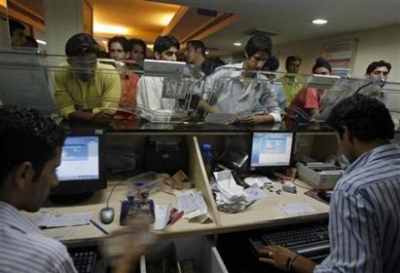
Poor governance, constant interference of promoters, opposition from unions and talks of being an acquisition target seen as main deterrents.

There hasn't been any dramatic moment in the first act (the Budget) but nobody would complain. It's par for the course as long as the figures don't change in the main Budget, which will be presented after general elections.

The festive season starts from August and last till December.

'To the believers of crypto regulations, I have only one question to ask, how will you regulate it?'

Market regulator Sebi suppressed important facts from the Supreme Court and "slept over" Directorate of Revenue Intelligence's letter on alleged stock manipulation by the Adani firms, one of the PIL petitioners in the Adani-Hindenburg row has alleged in the top court in an affidavit. The apex court is seized of four PILs on the Adani-Hindenburg controversy including those by lawyers M L Sharma and Vishal Tiwari, Congress leader Jaya Thakur and law student Anamika Jaiswal. On August 25, SEBI had informed the apex court it has completed the probe in all but two allegations against the Adani group, and is still awaiting information from five tax havens on the actual owners behind the foreign entities that have invested in the conglomerate.

Foreign flows into Indian equities are expected to pause in the short to medium term, say analysts. The outlook is influenced by multiple factors, including rising oil prices, actions from global central banks, climbing bond yields, and the dollar index gaining prominence. "Valuations appear rich with the markets at record highs.

Banks have raised concerns over the new international trade settlement in rupee, fearing that facilitation of such a mechanism could result in them facing the ire of economic sanctions by the West, people aware of the matter said. Large banks with overseas operations have sought clarity and assurance from the Reserve Bank of India (RBI) that they will not be targeted with sanctions for facilitating rupee trade with a sanction-hit country such as Russia. The present payment mechanism is a shift from earlier such arrangements, like the one with sanction-hit Iran, which involved banks facilitating settlement of international trade that did not have business in the sanctioned nation.

The comments come about a week after PSU bank employee unions went to a four-day relay strike to press for early revision of wages.
The Reserve Bank of India (RBI) will maintain the policy repo rate at 6.5 per cent during its upcoming June 8 announcement, considering the easing of retail inflation in April and the potential for further decline, indicating the effectiveness of previous policy rate actions, anticipate experts. Headed by Reserve Bank Governor Shaktikanta Das, a meeting of the six-member Monetary Policy Committee (MPC) is scheduled for June 6-8. The decision of the 43rd meeting of the MPC would be announced on Thursday, June 8.

The Piramal group and Zurich Insurance have decided to jointly bid for Reliance General Insurance, a subsidiary of Reliance Capital. The groups had earlier submitted separate bids for the general insurance business of bankrupt Reliance Capital. Both Piramal and Zurich will hold 50 per cent each in the proposed special purpose vehicle (SPV).

... while learning from past tech revolutions, suggests Ajit Balakrishnan.

While the economy seems to be on a firm growth path, the fight against inflation is not over yet. Shaktikanta Das seems to be in no hurry. After playing well through a five-year Test match, he doesn't want to get out hit wicket, observes Tamal Bandyopadhyay.

The target was for banks to sell Rs 2 trillion worth of non-performing assets to NARCL, the so-called 'bad bank, by 2021-2022. Only 10 per cent of this has been executed.
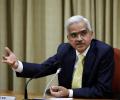
RBI Governor Shaktikanta Das on Wednesday defended the Reserve Bank's handling of the price situation, saying acting prematurely on inflation would have exerted a heavy cost on the economy and citizens. Acknowledging that the inflation target has been missed, Das said the RBI decided to support the economy by not introducing a rate hike in face of a spike in inflation. "We prevented a 'complete collapse of the economy' by keeping rates lower and stayed away from premature tightening," Das said speaking at the annual FIBAC conference of bankers in Mumbai.

Five Indian-origin women executives have made it to Barron's prestigious annual '100 Most Influential Women in US Finance' list for achieving positions of prominence in the financial services industry and helping shape its future. Barron's is a sister publication of the Wall Street Journal, published by Dow Jones and Company. "The list honours established and emerging leaders in financial services, the corporate world, nonprofit organisations, and government," the magazine said in a press release.

'There are occasions when the prices of individual items like food raise inflation; then supply-side measures must be taken.' 'But if there is continued inflation, it means liquidity is aggravating the situation.'

In Chanda's defence, one can always say, why would the Videocon Group take care of her husband as a quid pro quo to get a loan? After all, the group has taken money from the entire banking industry and ICICI Bank's share in the pie is not even 10 per cent. So, if it had a quid pro quo with Chanda to get the money, it must have had similar arrangements with other banks, too. If this is not the case, one must accept that it had got money from all banks, including ICICI, without any under-the-table conditions, points out Tamal Bandyopadhyay.

Capital markets regulator Sebi on Tuesday decided to gradually phase out buyback of shares by companies through the stock exchange route to address the drawbacks associated with the existing mechanism. Sebi chairperson Madhabi Puri Buch said the regulator has chosen the tender offer route for share buyback as the present mode is vulnerable to favouritism. "This is a glide path and will lead to the phasing out of the present buyback mode (through stock exchange route)," she told reporters after its board meeting in Mumbai.

The government will launch the mega public offer of LIC by March and file draft papers with market regulator Sebi by the end of this month, an official said. Finance Minister Nirmala Sitharaman had last week reviewed the progress of the initial public offering (IPO) of Life Insurance Corporation (LIC) in a meeting with top officials of the ministry. The official said the September 2021 quarter financials of LIC are getting finalised as well as fund bifurcation is in progress.

Byju's, India's most-valued startup, has decided to put two of its key assets -- Epic and Great Learning -- on the block to generate $800 million-$1 billion in cash, with an aim to meet the edtech firm's various commitments, including repaying the entire $1.2 billion term loan B (TLB) within six months, according to sources. The cash-strapped company has proposed repaying $300 million of the $1.2 billion loan in the next three months, depending on whether the lenders accept Byju's amendment proposal, said the people familiar with the development. "This loan repayment proposal has been submitted to the lenders and conversations are going in the right direction," said a person in the know.

All documents and data were safe as there was a Disaster Recovery Centre for every bank
.jpg)
Bankers remained ambivalent on the impact of Tuesday's policy announcement by Reserve Bank on the cost of funds and refrained from giving a guidance on the direction in which lending rates are headed.
The government is unlikely to come up with the IPO of Life Insurance Corporation (LIC) in the current financial year ending March 2022, as the valuation of the state-owned behemoth is taking more than anticipated time, and the preparatory work is still far from complete. There are still some issues that need to be addressed with regard to the valuation of LIC, a senior official of one of the merchant bankers said. Even after the valuation, there are several regulatory processes that have concluded, the official said.

For all its claims to economic glory, the majority of India's population lives vulnerable lives, a situation that has only worsened over the past 15 years, to the extent that the government now fears to release economic data or even conduct a proper Census, notes Rathin Roy.
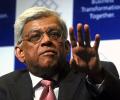
Noted banker Deepak Parekh on Thursday pitched for simpler corporate governance norms that focus more on trust than just compliance, saying economics and ethics are not trade-offs but complementary. Behind each financial crisis there is a governance failure but it is the entire system that gets impacted, because an eruption of a corporate or financial crisis almost always means a tightening of rules and regulations and increased compliance for all, he said. The HDFC chairman, who was addressing a seminar on corporate governance organised by former Sebi chairman M Damodaran's advocacy Excellence Enablers in Mumbai, stressed that the ultimate objective should be that corporate governance systems must become simpler and not more complicated.

Regulatory capacity, hyperactivity and excessive prescription are the biggest challenges the financial sector is facing, said Meleveetil Damodaran, former chairperson, Securities and Exchange Board of India (Sebi). Speaking at the Business Standard BFSI Summit on Wednesday, Damodaran highlighted the need for simpler, clear, and continuous regulations in the financial sector. He opined that the industry had felt it challenging to keep pace with the changing regulations.

Even as lenders are getting ready to send more companies to bankruptcy courts from this week, several old cases are still awaiting resolution with no clarity on the completion of the process. This includes some high profile cases from the first list of 40 companies including Videocon Industries, Bhushan Power and Steel and Lavasa Corporation, sent by the Reserve Bank of India (RBI) for resolution. The delay is mainly due to litigation and late clarifications by various government agencies including the Reserve Bank of India and litigation by the Enforcement Directorate.

One thing is for sure: It smacks of the regulator's lack of confidence in the bank's board, points out Tamal Bandyopadhyay.

Moitra brought two birthday caps in the House to press her argument that the businessman being most talked about had "topi-pehnau-ed" the government.

Fitch Ratings on Tuesday retained India's economic growth forecast at 7 per cent for the current fiscal, but cut projections for the next two financial years saying the country is not impervious to global developments. In its December edition of the Global Economic Outlook, Fitch projected India's GDP to grow at 7 per cent in the current fiscal, at a slower rate of 6.2 per cent in 2023-24 and at 6.9 per cent in 2024-25. In September, Fitch projected 7 per cent growth for the current fiscal, followed by 6.7 per cent in 2023-24 and 7.1 per cent growth in 2024-25.

With a view to protect prudent commercial decision of bankers, the government has taken a slew of decisions, including doing away with personal responsibilities of MD and CEO of PSBs for compliance in dealing with large value frauds committed by bank officials.

The average time lag between the date of occurrence of a fraud and its detection is 23 months; for large frauds (Rs 100 crore and above), it was 57 months.

The speed at which he led the central bank in different areas -- ranging from internal reorganisation to inflation fighting, stabilising the currency, taking on rogue corporations, cleaning up bank balance sheets, and opening the sector -- makes one believe that Rajan knew he had only three years to do his job. A fascinating excerpt from Tamal Bandyopadhyay's MUST-READ Roller Coaster: An Affair with Banking.

The most important step is delivering what is needed -- a fairer IPO pricing, notes Debashis Basu.

'If supply of cash is not sufficient from the RBI, it may create difficulty for both banks and people.'

The government on Wednesday appointed RBI's senior-most executive director M Rajeshwar Rao as the deputy governor of the central bank. Rao was appointed to the post vacated by N S Vishwanathan, who stepped down three months ahead of his extended tenure on health grounds.

For the initial public offering (IPO) of the Life Insurance Corporation of India (LIC), the Centre has shortlisted 50-60 anchor investors, which include BlackRock, Sands Capital, Fidelity Investments, Standard Life, and JP Morgan, and will soon finalise its anchor book. The feedback from anchor investors has led to price discovery in LIC shares, valuing India's largest insurer at around Rs 7 trillion, said an official aware of the development. The "attractive valuation" is seen widening the investor base by providing an opportunity to more of them to participate in the IPO, the official added.

Believe it or not, the regulator is even stretching its arm to identify stressed borrowers and gauge the 'distance to default' as a measure of a particular bank's fragility, reveals Tamal Bandyopadhyay.
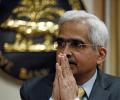
Uncertainty is emerging as the only certainty, said RBI Governor Shaktikanta Das as he emphasised on continued policy support at the December MPC meet during which members expressed concerns over spread of the Omicron variant of coronavirus, as per the minutes of the rate-setting panel released on Wednesday. After three days of deliberations, the six members of the Monetary Policy Committee (MPC) on December 8 unanimously voted for status quo on policy rates for the ninth consecutive time. At the meeting, the RBI Governor said risks stalking the global economy have amplified with rapid spread of the virus mutations, including the Omicron variant, leading to countries scrambling for restrictions.

The panel shortlisted bank chairmen who have headed an entity for at least two years and were less than 60 years of age when the vacancy arose. The list will now be narrowed down to three candidates who will be recommended to the appointments committee of the cabinet headed by Prime Minister Manmohan Singh. Their consent will be sought before sending the list to the ACC.
 © 2026 Rediff.com - Advertise with us - Disclaimer - Privacy Policy - Sitemap - Feedback - About us - Terms of use - Grievances